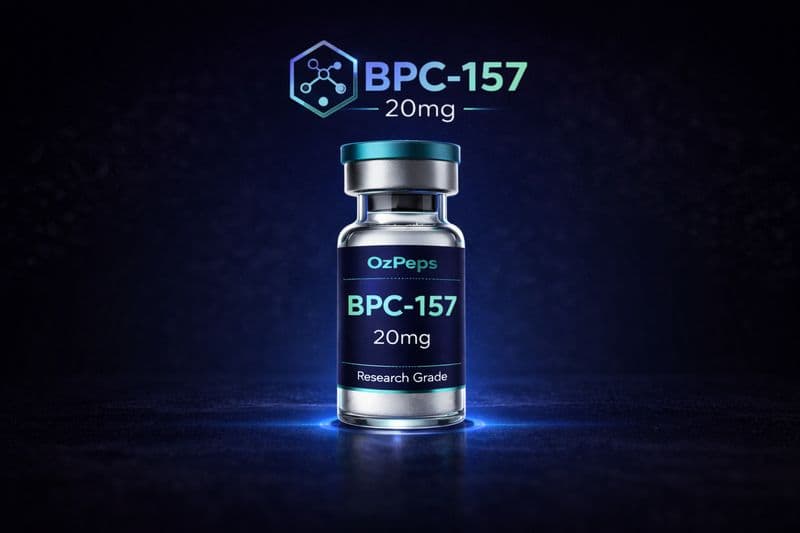
Product images are for illustration purposes only. Actual packaging and labelling may vary.
Buy BPC-157 20mg Australia
★★★★★4.7 · 10 reviewsResearch Use Only: For laboratory research purposes only. Not for human or animal consumption.
Description
BPC-157 (Body Protection Compound-157) is a synthetic pentadecapeptide (15 amino acids: Gly-Glu-Pro-Pro-Pro-Gly-Lys-Pro-Ala-Asp-Asp-Ala-Gly-Leu-Val) derived from a partial sequence of human gastric juice protein BPC. It demonstrates notable stability in human gastric juice and systemic activity across multiple administration routes. Mechanistically, BPC-157 activates VEGFR2 via the PI3K-Akt-eNOS axis to promote angiogenesis, stimulates ERK1/2 signalling to enhance fibroblast proliferation and migration, and modulates the NO system to regulate vascular tone. A 2025 systematic review (PMC, 36 studies, 1993-2024) found consistent improvement in tendon, ligament, muscle, and bone healing in animal models. A 2025 human pilot study reported no adverse cardiac, hepatic, or renal effects at IV doses of 10-20mg. This 20mg research vial supports in vitro and preclinical investigation of musculoskeletal repair, angiogenesis, and cytoprotective signalling. CAS: 137525-51-0. For research use only. Not for human consumption.
What Is BPC-157?
BPC-157 (Body Protection Compound 157) is a synthetic pentadecapeptide derived from a protective protein found in human gastric juice. The sequence consists of 15 amino acids: Gly-Glu-Pro-Pro-Pro-Gly-Lys-Pro-Ala-Asp-Asp-Ala-Gly-Leu-Val. It is stable in gastric acid and has been studied across a wide range of tissue models for over three decades.
Unlike many peptides, BPC-157 is orally active in animal models, which has made it an unusually versatile subject for research across gastrointestinal, musculoskeletal, and neurological contexts. It does not act through a single receptor pathway; instead, research points to interactions with the nitric oxide (NO) system, growth factor receptor upregulation, and modulation of several cytokine pathways.
Mechanism of Action
BPC-157 exerts its effects through several converging pathways. The most extensively documented involves upregulation of vascular endothelial growth factor (VEGF) and its receptor VEGFR2, promoting angiogenesis, the formation of new blood vessels, in injured tissue. This mechanism underlies much of the tendon and ligament healing research.
It also activates focal adhesion kinase (FAK) and paxillin signalling, facilitating cell migration to wound sites. Additionally, BPC-157 modulates the nitric oxide system: at low doses it appears to stimulate NO production via eNOS, while simultaneously protecting against NO-mediated toxicity. This dual action is thought to account for its observed cytoprotective effects in gastrointestinal and hepatic injury models.
Growth hormone receptor expression is another documented downstream effect, which has drawn interest from researchers studying musculoskeletal repair and recovery.
Research Evidence
Preclinical research on BPC-157 spans tendon and ligament repair, inflammatory bowel disease models, gastric ulcer healing, bone repair, and neurological injury. A 2010 study in the Journal of Physiology and Pharmacology demonstrated accelerated Achilles tendon healing in rats treated with BPC-157. Multiple studies in rodent models of colitis and NSAID-induced gastrointestinal damage have shown significant protective and healing effects.
In musculoskeletal models, BPC-157 has consistently outperformed controls in healing timeframes for tendon transection, muscle crush injury, and bone defect models. Neurological research has explored its effects in models of traumatic brain injury and spinal cord compression, with several studies reporting improved functional recovery versus vehicle controls.
Human clinical trials for BPC-157 have not been conducted as of 2026. All evidence derives from animal models and in-vitro studies. This compound is supplied for laboratory research use only.
Reconstitution & Storage
BPC-157 is supplied as a lyophilised (freeze-dried) powder. Reconstitute by adding bacteriostatic water slowly down the vial wall, 2ml per 20mg vial gives a concentration of 10mg/ml. Gently swirl until fully dissolved; do not shake or vortex. Store lyophilised powder at −20°C. Reconstituted solution should be refrigerated at 2–8°C and used within 4 weeks. Avoid repeated freeze-thaw cycles.
Research Guide Available , read the science, mechanism, and research data for this compound.
Frequently Asked Questions
Research Use Only: This product is for laboratory research purposes only. Not for human consumption. All compounds are sourced from suppliers with a verified Certificate of Analysis (COA).
Customer Reviews
Highly recommend.
Top notch service
Quality product.
Straightforward process.
Delivered faster than expected