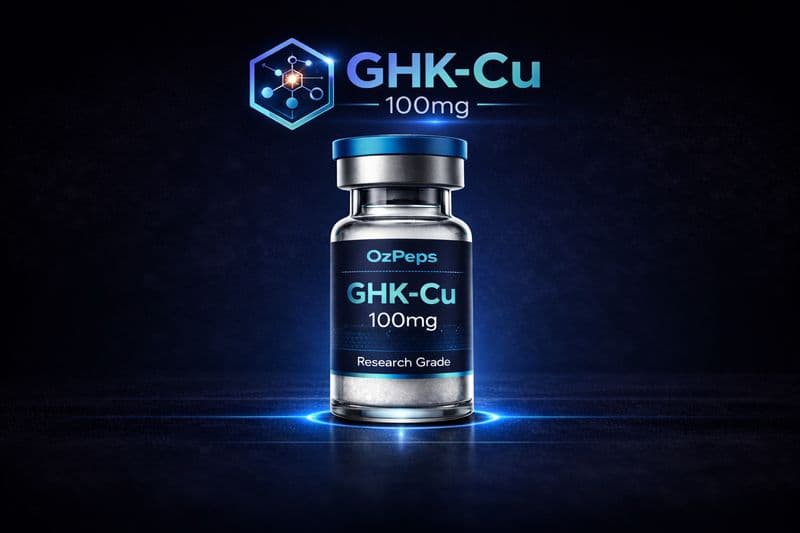
Product images are for illustration purposes only. Actual packaging and labelling may vary.
Buy GHK-Cu 100mg Australia
★★★★★4.9 · 9 reviewsDescription
GHK-Cu (Glycyl-L-histidyl-L-lysine copper complex) is a naturally occurring tripeptide-copper(II) complex first isolated from human plasma by Pickart in 1973. Plasma GHK-Cu concentrations decline with age, from approximately 200 ng/mL at age 20 to under 80 ng/mL by age 60, correlating with reduced skin repair capacity. Research demonstrates GHK-Cu modulates over 4,000 human genes, stimulates collagen I, III, and elastin synthesis, activates matrix metalloproteinases for extracellular matrix remodelling, promotes wound contraction and angiogenesis, and suppresses pro-inflammatory TNF-α signalling. GHK-Cu also upregulates VEGF and FGF, supporting its investigation in hair follicle research. This 100mg vial provides research-grade GHK-Cu for laboratory investigation of dermal biology, wound healing mechanisms, and copper-dependent peptide signalling. CAS: 49557-75-7. For research use only. Not for human consumption.
What Is GHK-Cu?
GHK-Cu (Copper Peptide GHK-Cu) is a naturally occurring tripeptide (glycine-histidine-lysine) complexed with copper(II) ions. It was first isolated from human plasma in 1973 by Loren Pickart. Endogenous GHK-Cu concentrations in blood plasma are approximately 200ng/mL in young adults and decline significantly with age, which has driven research interest in its potential roles in tissue maintenance and repair.
GHK-Cu is one of the most studied copper peptides in dermatological and wound healing research, with a substantial literature spanning hair follicle stimulation, wound contraction, angiogenesis, and anti-inflammatory signalling.
Mechanism of Action
GHK-Cu operates through multiple pathways. It stimulates collagen and glycosaminoglycan synthesis in fibroblasts, foundational to skin repair and wound healing research. It also promotes angiogenesis via VEGF upregulation, facilitating vascularisation of healing tissue.
In hair follicle research, GHK-Cu has demonstrated the ability to enlarge hair follicle size and extend the anagen (growth) phase of the hair cycle in murine models. Anti-inflammatory effects are well-documented: GHK-Cu downregulates TNF-α and other pro-inflammatory cytokines in wound models, shifting tissue from inflammatory to remodelling phase.
A 2012 review by Pickart and Margolina documented GHK-Cu's influence on over 4,000 human genes, predominantly affecting pathways related to tissue remodelling, anti-inflammatory response, and metabolic regulation.
Research Evidence
Hair loss research has produced some of the most clinically relevant GHK-Cu data. Multiple controlled studies in alopecia models have demonstrated follicle enlargement and increased hair density. A comparative study published in Skin Pharmacology and Physiology found GHK-Cu comparable to 5% Minoxidil in follicle stimulation metrics in a murine model.
Wound healing research consistently shows accelerated closure times and improved tensile strength of healed tissue in GHK-Cu-treated models versus controls. Dermal thickness and collagen density improvements have been documented in several controlled trials using topical GHK-Cu formulations.
Supplied for laboratory research use only. Not for human consumption or therapeutic application.
Reconstitution & Storage
GHK-Cu 100mg is supplied as lyophilised powder. Reconstitute with bacteriostatic water, 10ml per 100mg vial gives 10mg/ml. Store lyophilised powder at −20°C; reconstituted solution at 2–8°C for up to 4 weeks.
Research Guide Available , read the science, mechanism, and research data for this compound.
Frequently Asked Questions
Research Use Only: This product is for laboratory research purposes only. Not for human consumption. All compounds are sourced from suppliers with a verified Certificate of Analysis (COA).
Customer Reviews
Cheers for the quick send.
Tidy packaging, quick post.
No issues at all
Reliable supplier.
Product as described